

The Age of AI Advantage: Competing in an Intelligence-Driven World
AI and analytics have matured into core drivers of competitive advantage. To lead in today’s intelligence era, businesses must orchestrate strategy, systems, and talent around data-enabled decision making.
More than a decade ago, the rise of big data promised a new frontier in business value creation. Since then, we’ve witnessed a dramatic evolution: machine learning has leapt from experimentation into production, generative AI has reshaped content and interface design, and foundation models have enabled human-like reasoning at scale. Today, we’re not merely in the age of analytics—we’ve entered the age of AI advantage.
The opportunity is staggering. Research from McKinsey, BCG, and others suggests AI could add between $10 trillion and $15 trillion to global GDP over the next decade. Yet most organizations remain far from tapping that potential. The gap is not in technology. It’s in execution.
A New Landscape of Competitive Pressure
AI adoption is no longer an experimental edge—it’s a condition for survival. In sector after sector, we’re seeing an intelligence gap emerge:
- Retailers using AI-powered recommendation engines are outpacing competitors in conversion and margin.
- Manufacturers deploying predictive maintenance and process optimization are cutting costs by double digits.
- Financial institutions leveraging real-time risk scoring and agentic AI underwriting are setting new benchmarks in customer experience and portfolio growth.
- Healthcare providers using foundation models to extract meaning from clinical records are transforming diagnostics and patient engagement.
Those leading the charge have achieved not just isolated AI wins, but enterprise-wide transformation. They’ve moved beyond pilots to platforms, beyond hype to habits.
Why Most Companies Are Still Behind
Despite growing awareness and investment, many organizations—particularly mid-sized and traditional incumbents—struggle to scale AI and analytics. Common challenges include:
- Fragmented, siloed data systems that inhibit insight generation
- Talent shortages and unclear roles around AI and data science
- Low literacy at the leadership level, leading to misaligned priorities
- Over-reliance on external vendors without building internal capability
- Pilots that fail to transition into scalable, repeatable business systems
The outcome? Significant AI potential left untapped. And a rising risk of being overtaken by more agile, insight-driven competitors.
Three Strategic Imperatives for the Age of AI
To compete and win in today’s intelligence-driven economy, companies must focus on three critical transformations:
- Embed AI into Core Strategy
AI isn’t a tool—it’s a new way of designing how your business thinks, acts, and grows. Leaders must ask: Where can AI amplify our ability to make decisions? How can we use it to transform products, reimagine customer journeys, or even launch new business models? AI should be a boardroom topic, not just an R&D agenda. - Build an Execution-Oriented AI Architecture
Architecture isn’t just about tech. It’s about orchestration: connecting data, decisions, processes, and people. This means:- Leveraging modular, cloud-native platforms that allow for fast experimentation and industrialization
- Applying MLOps to manage the lifecycle of AI agents—from proof of value to scale and refinement
- Prioritizing interoperability to avoid vendor lock-in and futureproof the ecosystem
- Develop a Human-AI Operating Model
AI doesn’t eliminate people—it augments them. Winning companies invest in roles like AI translators and human-in-the-loop designers. They rewire incentives, update performance metrics, and build trust in AI systems by embedding governance and explainability. Above all, they cultivate an AI-literate workforce.
REVARTIS' Agent-Driven AI Integration Framework
At REVARTIS, we help organizations move from isolated AI experiments to synchronized value generation through our Agent-Driven AI Integration Framework. It includes six orchestrated steps:
- Leadership AI Awareness: Executive education workshops to align on AI’s strategic potential and limitations.
- Strategic Propulsion with AI: Facilitated sessions to define value creation hypotheses and test assumptions through prototypes.
- AI Assessment: Evaluate AI readiness across data, architecture, human capital, and business workflows.
- AI Agent Roadmap: Identify, prioritize, and sequence a pipeline of AI agents aligned with ROI, strategic relevance, and assistance rates.
- Orchestrate for Value: Deliver early impact through quick wins while laying the foundation for transformative agents over time.
- Synchronized Execution: Monitor, scale, and refine each agent with parallel evolution of your human capital and business architecture.
This framework allows mid-sized enterprises to build a self-financing AI roadmap—starting small, scaling smart, and adapting continuously.
From Gut-Driven to Evidence-Led: What Sets Leaders Apart
In past eras, experience and intuition were enough. Today, businesses must move at the speed of signal. What separates leaders:
- They use AI not just to automate decisions, but to improve their quality and speed.
- They treat AI not as an app, but as a layer across the enterprise.
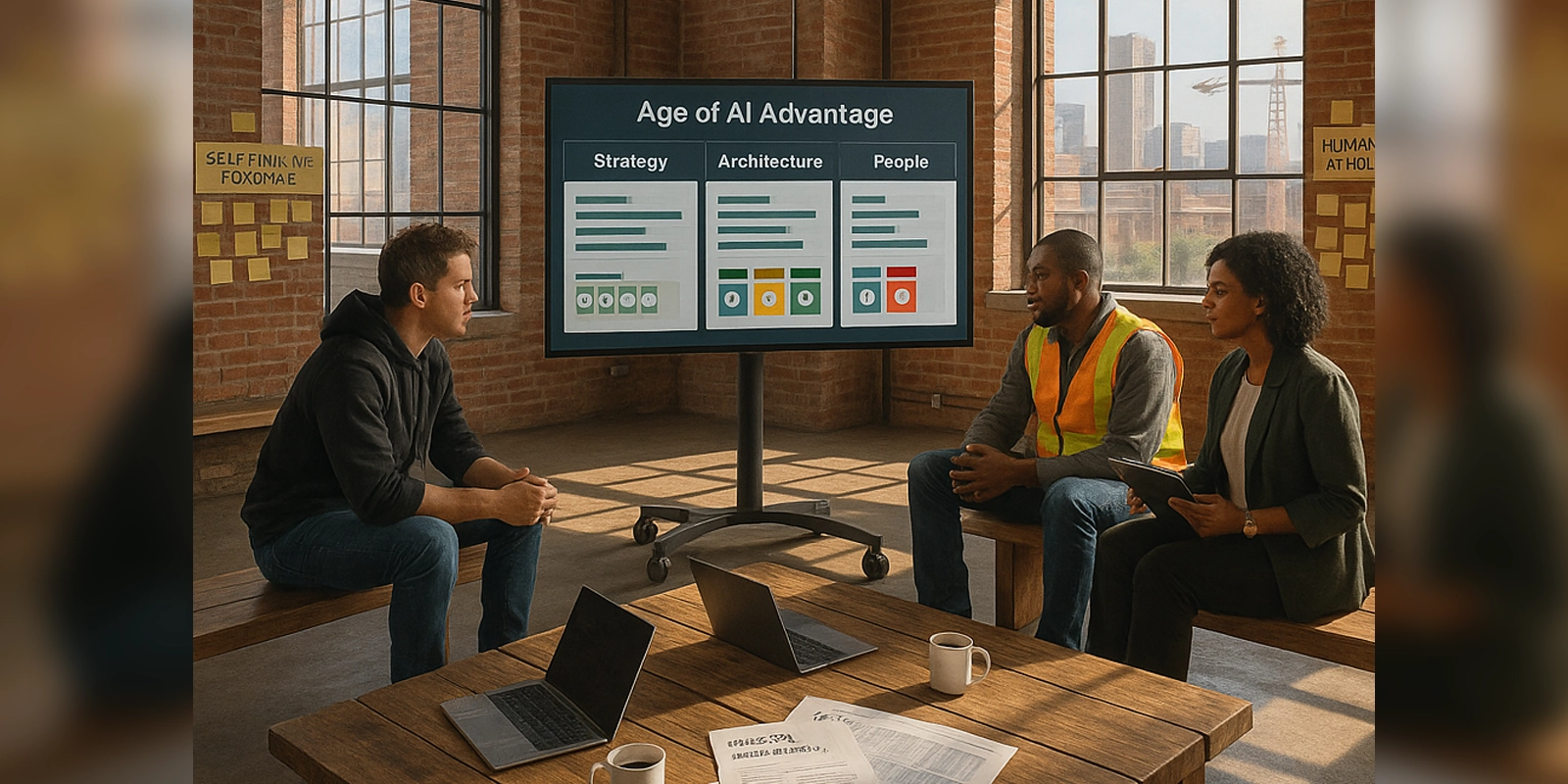
- They understand that success doesn’t come from the algorithm alone, but from the orchestration of AI with strategy, systems, and people.
A Note on Mid-Sized Enterprises: Your Advantage Is Still Ahead
Many mid-sized firms feel outpaced by tech giants and digital natives. But agility, clarity of purpose, and fewer legacy constraints offer an edge—if leveraged wisely.
- Start with one or two high-impact agents: customer service automation, predictive pricing, or fraud detection.
- Let these early successes fund a self-financing AI roadmap.
- Build fluency at the top: align the C-suite with a shared view of AI potential, risk, and responsibility.
The Age of AI Advantage Is Now
We are no longer waiting for the AI revolution. It is here—and unevenly distributed. Companies that act now can still shape their trajectory. Those that wait risk being shaped by it.
At REVARTIS, we believe AI should not be an enigma, a lab experiment, or a buzzword. It should be a business capability—deployed with purpose, scaled with clarity, and governed with integrity.
The question is no longer “Should we adopt AI?” It is: “Where, how fast, and with what value at stake?”
Author
Dr. Said Oualibouch
Frequently Asked Questions
In an intelligence-driven world, competitive advantage increasingly comes from an organization’s ability to leverage AI, data, and human insights to make faster, smarter decisions. Traditional sources of advantage — scale, efficiency, even digital presence — are no longer sufficient. Intelligence becomes the differentiator.
AI enables organizations to sense, decide, and act faster than competitors. It reduces time-to-insight, enhances personalization, automates decision-making, and unlocks new value streams. When integrated strategically, AI not only improves productivity but reshapes business models and operating models.
Not necessarily. Many companies adopt digital tools but stop short of integrating AI into core processes, decision-making, and innovation workflows. AI advantage requires not just tools, but a deliberate strategy that embeds intelligence into the enterprise DNA.
Organizations that lead with AI typically share five traits:
-
Executive-level AI sponsorship
-
Clear alignment between AI initiatives and business goals
-
Robust data infrastructure and governance
-
Cross-functional collaboration and agile execution
-
Ongoing investment in talent, ethics, and AI literacy
Yes — but they must play to their strengths: speed, focus, and proximity to customers. With the right framing and support, mid-sized companies can leapfrog larger competitors by implementing targeted, strategic AI agents that deliver business value quickly.
Shift from isolated pilots to a roadmap-driven by a (YOUR) strategic shift. Define strategic priorities, map AI to specific value levers, and build a portfolio of AI agents linked to measurable outcomes. This is the essence of the Agent-Driven AI Integration approach.
It’s our framework for deploying AI as modular, goal-oriented agents across the organization. Each agent supports or automates a specific activity, is embedded into workflows, and is aligned with both strategic objectives and human capital. The result: a synchronized roadmap where AI scales sustainably.
Leadership sets the direction, culture, and pace. Without executive sponsorship, AI remains experimental. CEOs and boards must treat AI as a strategic lever, ensure cross-functional alignment, and build the governance, metrics, and capabilities needed for long-term impact.
Responsible AI should be built in from the start. This includes:
-
Clear ethical guidelines and risk assessment
-
Transparency in AI decision-making
-
Human oversight in sensitive areas
-
Compliance with emerging AI regulations
REVARTIS embeds AI governance by design into all transformation roadmaps.
We work with executive teams to:
-
Clarify AI’s role in your strategy
-
Design your AI transformation roadmap
-
Deploy strategic AI agents with measurable business impact
-
Build internal AI literacy and human capital alignment
-
Ensure scalability, governance, and adoption
Whether you’re starting with your first AI agent or orchestrating enterprise-wide transformation, we partner with you to move from experimentation to competitive edge.
Let's define together the Path to Your Success.
Book Your Strategic Session - It's free